Hot Sauce Nutrition Label: FDA Rules and Requirements
Create a hot sauce nutrition label using FDA rules for serving size, ingredients, allergens, small bottles and acidified foods. Free JPG export.
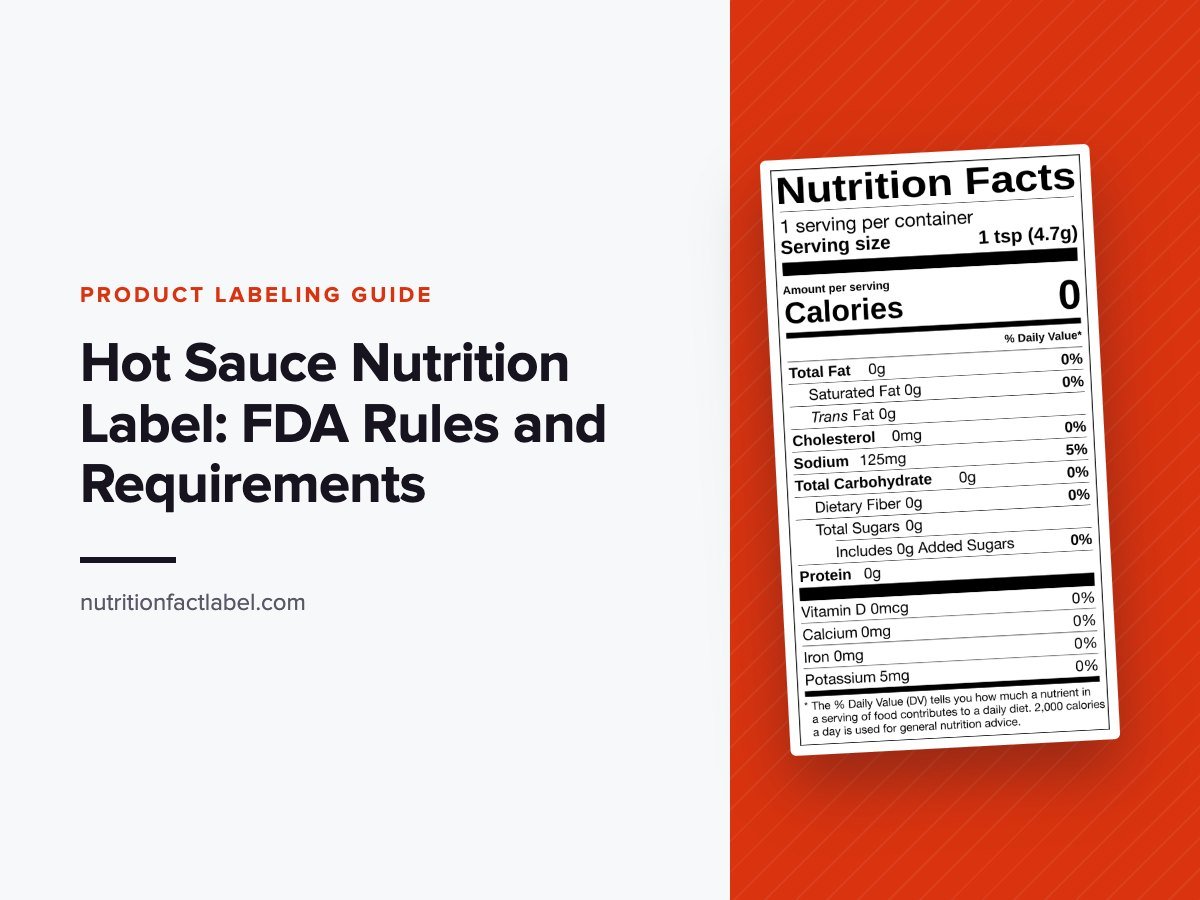
A hot sauce nutrition label normally uses a serving size of 1 teaspoon, based on the FDA RACC for minor condiments such as hot sauces. The finished Nutrition Facts panel must also follow the formatting and nutrient declaration requirements in 21 CFR 101.9. FDA lists hot sauces under minor condiments with a RACC of 1 teaspoon, or 5 mL.
This guide is for hot sauce makers moving from farmers markets, local sales or home production into retail. If you are researching how to start a hot sauce business or how to sell hot sauce at retail, it explains the basic US labeling and food-regulation steps without assuming that you already understand FDA terminology.
Hot sauce nutrition label requirements at a glance
A retail hot sauce bottle generally needs several pieces of information beyond the Nutrition Facts panel. These elements identify the food, show how much is in the package and tell consumers who is responsible for the product.
- Statement of identity: The label identifies what the product is, such as "Hot Sauce," "Habanero Hot Sauce" or another appropriate common or usual name. The statement of identity normally appears on the principal display panel under 21 CFR 101.3.
- Net quantity of contents: The principal display panel states how much product the bottle contains. A liquid hot sauce normally declares volume using US customary and metric units as required by 21 CFR 101.7.
- Nutrition Facts label: The hot sauce Nutrition Facts label displays serving information, calories, required nutrients and applicable %DV values. Nutrition labeling requirements appear primarily in 21 CFR 101.9.
- Ingredient statement: The ingredient list identifies ingredients in descending order of predominance by weight. Ingredient declaration requirements appear in 21 CFR 101.4.
- Manufacturer, packer or distributor information: The label identifies the responsible business by name and place of business in accordance with 21 CFR 101.5.
Some qualifying businesses or low-volume products may use the small business nutrition labeling exemption under 21 CFR 101.9(j). Eligibility has specific conditions, and certain nutrition claims can affect whether an exemption is available.
For most new retail brands, the next question is how to determine the correct serving size.
Hot sauce serving size and RACC
The standard hot sauce serving size is generally 1 teaspoon, or 5 mL, because FDA regulations specifically list hot sauces as minor condiments.
A RACC, or Reference Amount Customarily Consumed, is the FDA reference quantity used to determine the labeled serving size for a category of food. In 21 CFR 101.12, FDA groups horseradish, hot sauces, mustards and Worcestershire sauce under "minor condiments." The RACC for this category is 1 teaspoon, and the example label statement is 1 teaspoon with the corresponding gram weight or 5 mL for a liquid product. You can confirm the category with the RACC lookup tool.
Consider a typical 5 fl oz woozy bottle. Five US fluid ounces is approximately 148 mL. Dividing 148 mL by a 5 mL serving gives approximately 29.6 servings.
Your servings-per-container declaration must follow the applicable FDA rules for determining and expressing the number of servings, so do not automatically print "29.6 servings" from the raw calculation. Use the applicable rounding and serving size rules in 21 CFR 101.9.
The small serving also explains why hot sauce panels can look unusual. A teaspoon of pepper, vinegar and salt contains very little food by weight compared with products such as bread, cereal or snacks. Calories, fat and carbohydrate may therefore fall below the thresholds that allow them to be displayed as zero after FDA rounding rules are applied.
Sodium is different. A small serving can still contain a meaningful amount of sodium if your recipe uses substantial salt, brine or salty ingredients.
Once the serving is correct, you need a Nutrition Facts format that physically fits the bottle.

Which Nutrition Facts format fits a hot sauce bottle
A hot sauce bottle can use an alternative Nutrition Facts format when the package meets the FDA conditions for limited labeling space.
The challenge is common with 5 oz woozy bottles. The bottle is narrow, and your label may also need room for branding, ingredients, net contents, business information, a UPC and other required information. You cannot simply shrink a standard Nutrition Facts panel until it fits.
Under 21 CFR 101.9(j)(13), packages with 40 square inches or less of total surface area available to bear labeling can use modified presentation rules in qualifying situations. A package with less than 12 square inches available for labeling, or a qualifying package of 40 square inches or less that cannot accommodate the standard format because of its shape or size, may use a tabular nutrition label.
A linear nutrition label presents the nutrition information in a string-like arrangement. FDA regulations allow the linear presentation only when a qualifying package cannot accommodate the tabular display.
Small-package formats still have typography requirements. For example, 21 CFR 101.9 specifies that "Calories" is generally at least 16 point in the standard presentation, but the small-package tabular and linear formats permit a minimum of 10 point for that heading. The calorie number is generally at least 22 point, while qualifying small-package formats permit 14 point. Serving information also has specific minimum sizes.
The PDP calculator works out your available label area and the type sizes that apply to it.
Packages with less than 12 square inches of available labeling surface may qualify for a separate nutrition-labeling exemption if additional conditions are met, including restrictions on nutrition claims and providing a way for consumers to obtain nutrition information.
The bottle dimensions determine the format, but your recipe determines the numbers inside it.
Getting hot sauce nutrient values
Database-based recipe analysis works well for many straightforward hot sauces when you have accurate ingredient weights, reliable ingredient nutrition data and a known finished batch yield.
A basic recipe might contain fresh peppers, vinegar, water, garlic and salt. You can enter each ingredient by weight in recipe nutrition analysis, record the total finished yield and calculate the nutrients contributed to a 1 teaspoon serving. Supplier nutrition specifications are useful when you use commercially prepared ingredients instead of basic raw ingredients.
For many sauces, sodium deserves particular attention. Salt, brine, soy sauce, Worcestershire sauce and other prepared ingredients can contribute significant sodium even though the serving contains very few calories. Do not assume that a small serving automatically means an insignificant sodium value.
Fermented sauces need additional care because fermentation, brining, draining and processing can make a simple ingredient calculation less representative of the final sauce. The same concern applies when you remove solids or liquid after processing.
Oil-based sauces also need careful formulation because a small amount of added oil can materially change fat and calorie values.
A laboratory test is not automatically required for every sauce Nutrition Facts label. Database analysis can be appropriate when the formulation and finished yield are known and the underlying ingredient data are dependable. More complex processing may justify laboratory analysis or professional review.
Once the nutrient data is established, build the ingredient and allergen declarations from the actual formula.
Ingredient statement and allergens for hot sauce
A hot sauce ingredient label lists ingredients in descending order of predominance by weight, using the ingredients as they are added to the formula.
If peppers are the heaviest ingredient when the batch is formulated, peppers normally appear first. If vinegar weighs more than the peppers, vinegar normally appears first. Added water follows the same principle. Do not reorder vinegar, water or peppers because one sequence looks more natural to a customer.
21 CFR 101.4 requires ingredients to be declared by their common or usual names and generally in descending order of predominance by weight. The ingredient formatter builds the statement in the required order and style.
Spices may sometimes be declared collectively as "spices" under 21 CFR 101.22(h)(1). Ingredients that FDA does not treat as spices, such as paprika, turmeric and saffron (which are also color additives), or dehydrated vegetables such as garlic and onion powder, need their individual names. Natural flavors are defined in 21 CFR 101.22(a)(3) and may be declared as "natural flavor," but any allergen they contain still has to be declared.
Many simple pepper-and-vinegar hot sauces contain none of the nine major food allergens. More complex recipes can.
A sauce containing conventional soy sauce may introduce soy and wheat, depending on the soy sauce formulation. A sauce containing fish sauce can introduce fish. Other recipes may use sesame, milk or additional allergen-containing ingredients.
Federal law recognizes milk, egg, fish, Crustacean shellfish, tree nuts, peanuts, wheat, soybeans and sesame as major food allergens. When one is present, your label must identify the applicable food source in the manner required by federal allergen labeling rules. The allergen detector flags allergen sources hiding in compound ingredients.
Finishing the ingredient label does not necessarily finish the regulatory work for a shelf-stable sauce.
FDA hot sauce regulations for acidified foods
Shelf stability and acidified-food compliance are separate from nutrition labeling, so a correct Nutrition Facts panel does not by itself make a hot sauce ready for commercial shelf-stable distribution.
FDA defines an acidified food as a low-acid food to which acid or acid foods are added, with water activity above 0.85 and a finished equilibrium pH of 4.6 or below. The regulation specifically includes peppers among examples, but it also excludes some acid foods and condiment sauces when they meet the regulatory exclusion.
This means you should not assume that every hot sauce is legally an acidified food.
When a sauce falls under the acidified-food rules, commercial processors must follow a scheduled process established by a qualified person with appropriate expertise. The regulations also require control of finished equilibrium pH and other processing conditions.
Commercial processors of acidified foods must also register the establishment with FDA and file the scheduled process for each product under 21 CFR 108.25 before distribution. Many businesses work with a process authority to determine product classification and establish the appropriate scheduled process.
Treat this as a separate food-safety compliance step from creating your Nutrition Facts panel.
Create your hot sauce nutrition label free
You can create a free FDA compliant Nutrition Facts panel for your hot sauce with the NFL label generator once you have your serving size and nutrient values.
- Select the US FDA label format.
- Enter the serving size, such as 1 teaspoon with the applicable metric quantity, and add the number of servings per container.
- Enter the nutrient values for one serving.
- Review calories, sodium, fat, carbohydrate, sugars, protein and the other required nutrients.
- Choose the Nutrition Facts format appropriate for your bottle.
Do not select a smaller format purely because it looks better. The package must qualify for the applicable FDA presentation.
NutritionFactLabel creates the FDA compliant US label for free. You do not need an account or credit card. The free version has no watermark and lets you export the finished Nutrition Facts panel as a JPG.
Generate the nutrition panel first, then place it with your ingredients, allergens and other required package information.
Hot sauce nutrition label FAQ
What is the serving size for hot sauce?
The FDA RACC for hot sauce is 1 teaspoon, or 5 mL. FDA regulations list hot sauces under minor condiments in 21 CFR 101.12. Your label should also provide the appropriate metric quantity, and you must calculate servings per container using the applicable FDA serving rules.
Does hot sauce need a nutrition label?
Most packaged hot sauce sold at retail needs nutrition labeling unless the product qualifies for an applicable exemption. Small businesses and low-volume products may qualify under 21 CFR 101.9(j), but eligibility has conditions. Nutrition or health claims can also affect exemption eligibility, so confirm your status before omitting the panel.
Why does my hot sauce label show zero calories?
Your hot sauce may show zero calories because the 1 teaspoon serving contains a very small amount of energy and FDA rounding rules can permit low values to be declared as zero. This does not mean the entire bottle contains zero calories. The Nutrition Facts panel reports values for the declared serving.
Do I need a lab test for my hot sauce label?
No. A laboratory test is not automatically required for every hot sauce nutrition label. Database analysis can work for recipes with reliable ingredient data, exact quantities and a known finished yield. Fermentation, substantial processing, variable ingredients or unusual formulations can make laboratory testing or professional analysis more appropriate.
What are the label requirements for hot sauce?
A retail hot sauce bottle needs a statement of identity such as "hot sauce," the net quantity in fluid ounces on the principal display panel, a Nutrition Facts panel unless an exemption applies, the ingredient list in descending order by weight, any major allergens, and the name and address of the manufacturer, packer or distributor. Many shelf-stable hot sauces are acidified foods, and for those the processor also files a scheduled process with FDA under 21 CFR 108.25 and follows 21 CFR Part 114. That is a processing requirement rather than a label element, and a sauce that is naturally an acid food or is sold refrigerated is excluded from the acidified food definition in 21 CFR 114.3(b).
Does hot sauce need FDA approval?
No. FDA does not approve hot sauce recipes or their labels before they are sold. Many commercial hot sauces are acidified foods, and for those the processing facility registers with FDA, files its scheduled process and follows the acidified foods rules in 21 CFR Part 114. The brand is responsible for a truthful, compliant label, and FDA can act after the product is on the market.
Bottling this weekend? Build your hot sauce panel now in the free NFL label generator, no account, no watermark.